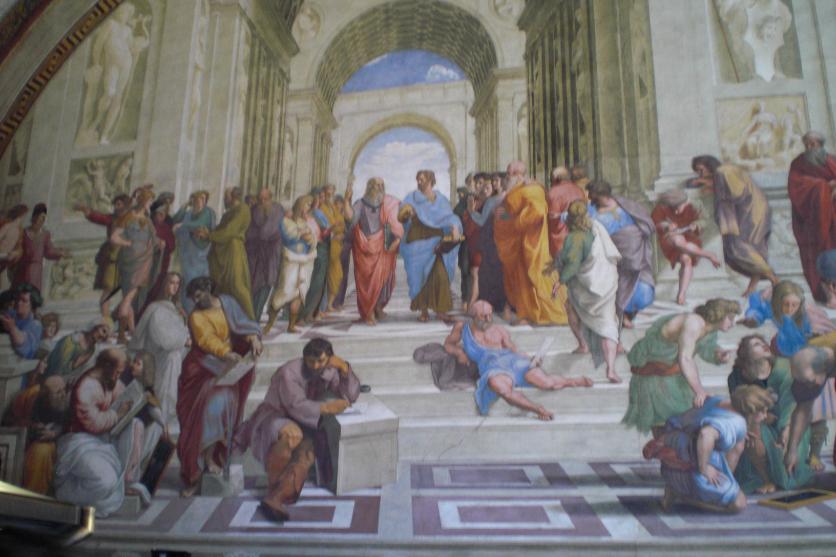
Key Vocabulary Terms:
ALLEGORY: Figurative and/or metaphoric message
BALANCE: the way art elements are arranged to create a feeling of stability, or instability in a composition. The simplest type of balance is symmetry — an equal, regular arrangement of forms on either side of a central axis. Another type of balance is asymmetry, in which stability is achieved with differing elements that have equal visual weight or equal eye attraction.
CANVAS: Heavy, course and closely woven fabric made of cotton, flax or hemp; what an artist paints on
CHIAROSCURO: In drawing or painting the treatment and use of light and dark, especially the gradations of light that produce the effect of modeling
COLOR: Color refers to specific hues. The color wheel is a tool used to organize color. It is made up of:
•Primary Colors – Red, Yellow, Blue – These colors cannot be mixed, and must be bought in some form (they were found naturally in nature and made into paints, for example).
•Secondary Colors – Orange, Violet, Green – These colors are created by mixing two primaries.
•Tertiary Colors – Red-Orange, Yellow-Green, Blue-Violet, etc.; mixing a primary with a secondary creates these colors
Color Schemes
•Complementary Colors – Colors that are opposite each other on the color wheel
•Analogous Colors – Colors that are next to each other on the color wheel, for example red, red-orange, and orange are analogous colors.
•Monochromatic – One color is used but in different values and intensities, such as red and several shades of pink.
•Warm Colors – On one side of the color wheel, they give a feeling of warmth and are the colors of fire: Red, Orange, Yellow.
•Cool Colors – On the other side of the color wheel, they give a feeling of coolness, water, and cool grass: Blue, Violet, Green
COMPOSITION: the arrangement of shapes, forms, colors, areas of light and dark, and other elements in a work of art.
CONTRAST: showing the difference between lights and darks in a picture.
EMPHASIS: an area within a design that is meant to be seen or is more important to be noticed when compared to other places of the design.
FORESHORTENING: The use of perspective to represent the apparent visual contraction of an object that extends back in space at an angle to the perpendicular plane of sight.
FORM: a three-dimensional object, having height, width, and depth (thickness).
GRISAILLE: A monotone painting done mainly in neutral grays to simulate sculpture.
ICONOGRAPHY: the collections, description or study of images used in works of art.
LINE: the path of a point (a point being a dot… when you follow the path of a dot, it creates a line). A line can also be defined as a mark on a surface that connects two points.
Types of Lines: •Contour Lines •Gesture Lines •Implied Lines
Characteristics of Line: •Width •Length •Direction •Focus
MEDIUM: the material with which an artist works (marble, clay, paint, wood, ink, etc.).
MOVEMENT: refers to the suggestion or illusion of motion in a design, showing action.
PERSPECTIVE: A method of presenting an illusion of the three-dimensional world on a two-dimensional surface.
LINEAR PERSPECTIVE
All parallel lines converge on one, two or three vanishing points located with reference to the eye level of the viewer (the horizon line of the picture). Objects are rendered smaller so that they appear farther away from the viewer.
ATMOSPHERIC (AERIAL) PERSPECTIVE
Creates the illusion of distance by diminution of color intensity. The shift in color is almost to neutral blue and the blurring of contours creates distance between eye and object.
PROPORTION: describes the sizes of objects in artwork, and their relationship to one another.
REPETITION: the occurrence of something again in the same form. Regular repetition is a characteristic of pattern.
RHYTHM: is a movement in which some element recurs regularly (Repetition).
SCALE: the size of an object; the size of a work of art.
SHAPE: when a line starts and ends at the same point, crosses itself, or intersects with other lines to enclose space. Categories of Shapes •Geometric Shapes •Organic Shapes
SPACE: refers to the distance or area between, around, above, below, or within things. Some art forms are three-dimensional (having height, width, and depth) and physically occupy space; others begin with a two-dimensional surface and may create the illusion of space or depth. •Positive Space •Negative Space
STILL LIFE: A picture depicting an arrangement of inanimate objects
SUBJECT MATTER: the subject of a work of art, what the work of art is "about."
TEXTURE: is the surface quality, either tactile or visual. Texture can be real or implied.
UNITY, or HARMONY: Unity, also known as harmony, brings together a composition with similar units… when things look right together. Each part of a design should make the whole design feel complete.
VALUE: Value is the range of lightness and darkness within a picture.
Categories of Values •Tint •Shade •Value Contrast •Value Scale
